What Packaging Features Matter When Importing Night Vision Binoculars in Bulk?
When importing night vision binoculars in bulk, the most important packaging features are product protection, clear retail information, compact shipping dimensions, organized accessories, and shelf-ready presentation. For small retailers, good retail packaging is not simply about appearance—it can reduce shipping damage, make products easier to sell online and in stores, and improve the efficiency of inventory handling.
For buyers planning a bulk import of night vision binoculars, the best packaging is therefore a balance between protection, retail presentation, logistics efficiency, and customer usability.
Why Does Retail Packaging Matter When Buying Night Vision Binoculars in Bulk?
Retail packaging matters because every imported unit has to survive transportation and then become a sellable product. A package that protects the binoculars but looks confusing on a retail shelf may create a different problem: the retailer receives inventory, but the customer cannot quickly understand what the product does.
For small B2B buyers, packaging affects several stages of the product lifecycle:
- International transportation: protects the binoculars from impact, compression, dust, and moisture.
- Warehouse handling: makes cartons easier to stack, identify, and count.
- Retail display: communicates the product category and major features.
- E-commerce fulfillment: provides a professional package for customers receiving the product.
- Returns: organized packaging makes it easier for customers to repack the product.
Penn State Extension notes that packaging, shipping, and pickup methods can affect customer satisfaction and the likelihood of customers purchasing again. Packaging materials also need to be selected with cost and product requirements in mind.
B2B takeaway: When importing night vision binoculars in bulk, evaluate packaging as part of the complete product—not as an afterthought.
What Should Be Included on Night Vision Binoculars Retail Packaging?
The front of the retail package should communicate the product category and its strongest selling points quickly, while the back or side should provide more detailed information. This is especially important for night vision binoculars because many first-time buyers may not understand technical terms such as IR illumination, digital zoom, image resolution, or recording functions.
A practical retail package should clearly identify:
| Packaging Information | Why It Matters |
|---|---|
| Product name | Helps customers identify the product immediately |
| Model number | Useful for inventory and customer support |
| Key features | Communicates the main buying reasons |
| Photo of the product | Helps customers understand the physical design |
| Basic specifications | Reduces uncertainty before purchase |
| Included accessories | Shows what the customer receives |
| Manufacturer/brand information | Supports product identification |
| Barcode/UPC area | Helps retailers manage inventory |
| Website or QR code | Provides access to manuals or support |
| Compliance/safety information | Supports responsible product distribution |
The Federal Trade Commission advises consumers to pay attention to complete product descriptions, model numbers, features, delivery information, and seller policies when shopping online. Clear packaging supports the same principle at the physical-product level: important information should be easy to find rather than hidden in dense text.
How Important Is Packaging Protection for Bulk Imports?
Packaging protection is one of the highest-priority considerations for bulk imports because a small percentage of damaged units can quickly become a meaningful cost when hundreds of products are involved.
Night vision binoculars contain optical components, electronic components, displays, buttons, infrared illumination systems, and batteries or battery compartments. Packaging should therefore prevent the device from moving excessively inside the box during transportation.
A useful packaging structure typically includes:
- A fitted inner tray or protective insert
- Cushioning around the main device
- Separate storage for accessories
- Protection for lenses and screens
- A strong outer retail carton
- Additional master-carton protection for bulk transportation
The objective is not simply to use more material. The better objective is controlled protection with minimal unnecessary packaging volume.
This distinction matters because oversized packaging can increase warehouse space and transportation costs. For a small retailer, packaging efficiency can therefore influence the landed cost of every unit.
What Makes Packaging Suitable for Bulk Import Logistics?
Bulk-import packaging should be designed for both individual retail units and master cartons. Retail packaging protects and presents one product, while master cartons need to make transportation and warehouse management efficient.
For example, a supplier should be able to answer questions such as:
- How many retail units fit into one master carton?
- What are the master-carton dimensions?
- What is the gross weight?
- Can cartons be safely stacked?
- Is the inner packaging fixed tightly enough to prevent movement?
- Are individual units easy to remove without damaging other packages?
- Are cartons clearly marked with model and quantity information?
This is particularly important for small wholesale buyers because they may receive mixed shipments or store inventory in relatively limited warehouse space.
A useful rule: calculate packaging efficiency at the carton level, not only at the individual-unit level.
Should Retail Packaging Be Compact or Premium?
For night vision binoculars, the best retail packaging is usually compact, protective, and visually professional rather than unnecessarily luxurious.
A premium-looking package can help communicate product value, but excessive packaging may increase dimensional weight, storage requirements, and material costs.
Small retailers can compare packaging using four practical indicators:
| Packaging Type | Protection | Retail Appeal | Shipping Efficiency | Best For |
|---|---|---|---|---|
| Basic carton | Medium | Low | High | Price-focused products |
| Standard retail box | High | High | High | Most small retailers |
| Premium rigid box | Very high | Very high | Medium | Gift-oriented products |
| Oversized decorative box | High | High | Low | Limited use cases |
Our recommendation for most B2B buyers is the standard retail box: strong enough for transportation, attractive enough for store shelves, and compact enough for e-commerce fulfillment.
What Packaging Features Help Night Vision Binoculars Sell Online?
E-commerce changes what “good packaging” means because customers may never see the product on a physical shelf before purchasing. The packaging should therefore reinforce the information customers encounter in product listings.
The packaging should make major product attributes easy to understand, such as:
- Night vision capability
- Image or video resolution
- Magnification
- Infrared illumination
- Recording capability
- Intended use
- Included accessories
- Power requirements
This creates consistency between the product listing, product itself, and retail package.
The U.S. Census Bureau reported that U.S. retail e-commerce sales reached an estimated $340.2 billion in Q2 2026, representing 17.1% of total retail sales for the quarter. E-commerce sales were also up 12.2% from Q2 2025.
For small retailers, this suggests that packaging should be designed not only for physical shelves but also for the unboxing experience created by online orders.
How Does Packaging Affect the Customer's First Impression?
Packaging creates the first physical interaction between a customer and a product. For technical products such as night vision binoculars, clear information can be particularly valuable because customers may need reassurance that they purchased the correct model.
Michigan State University Professor Patricia Huddleston studies consumer information processing and how shoppers respond to point-of-purchase displays. Her research includes eye-tracking work examining which retail information attracts consumer attention and how it relates to purchase intention.
This supports a practical packaging principle:
Make the most important information easy to see before making the customer search for it.
For night vision binoculars, that usually means putting the product name, product image, and several major benefits in prominent positions rather than filling the front panel with technical specifications.
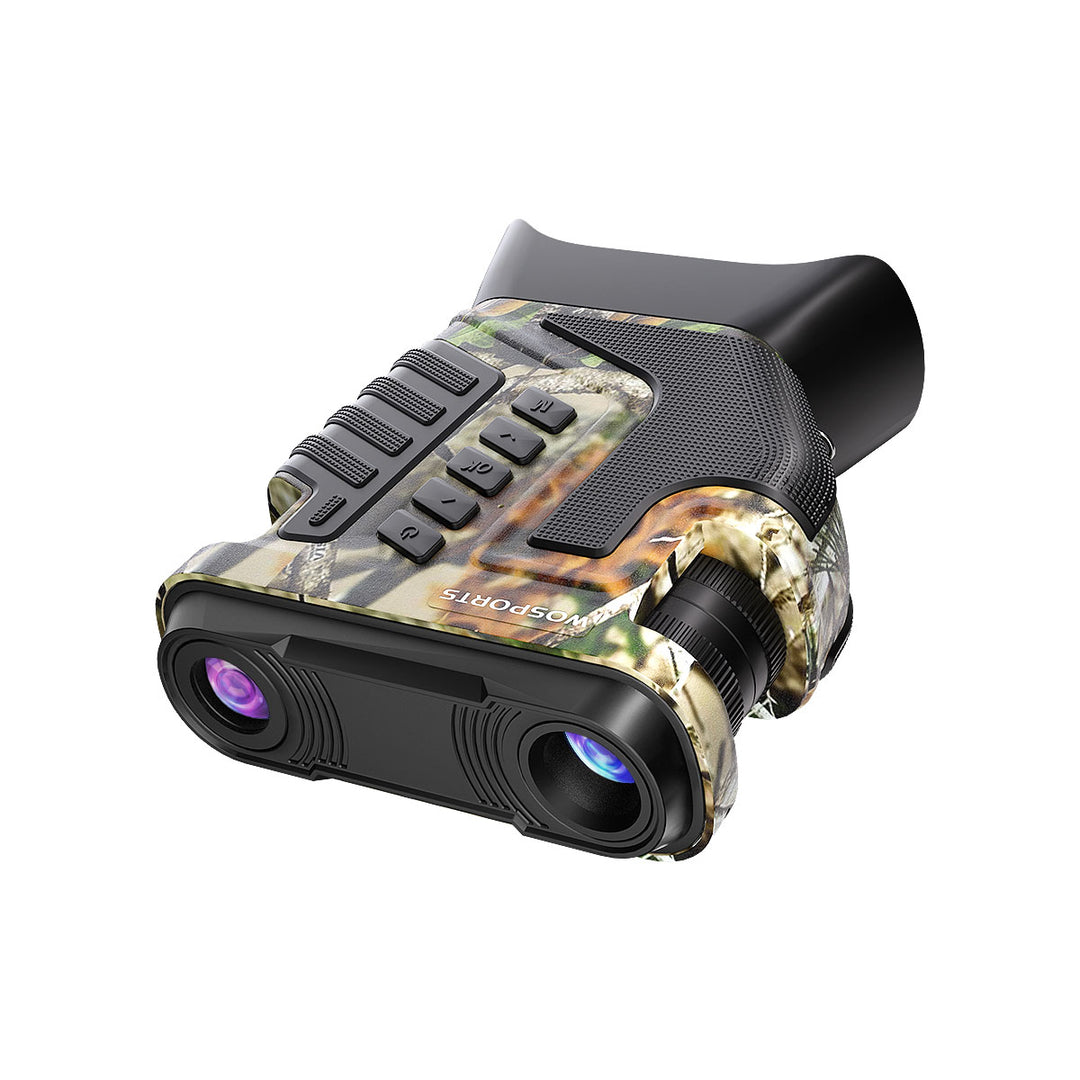
What Retail Packaging Works Well for a Product Like the WOSPORTS NV400?
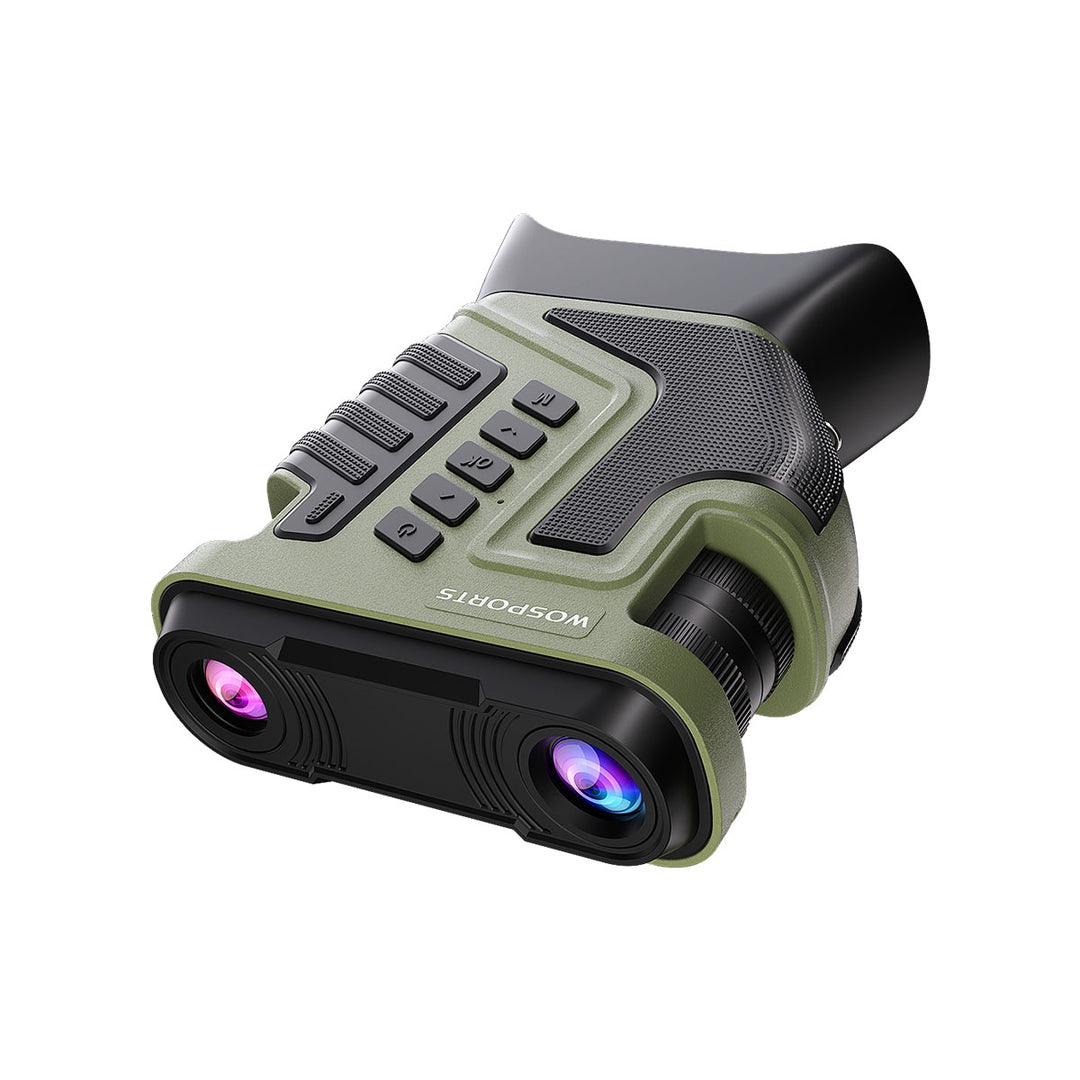
The WOSPORTS NV400 is a good example of why night vision binoculars need packaging that communicates several product benefits without becoming visually complicated.
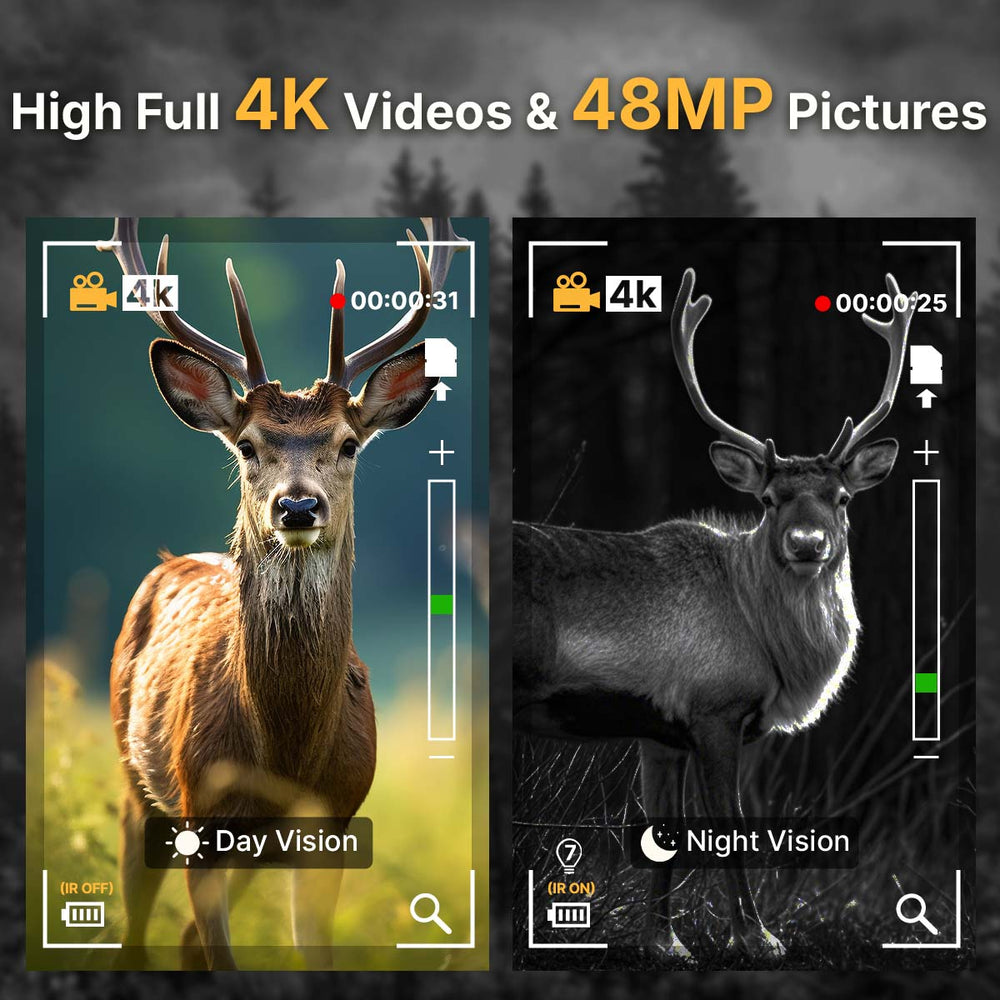
The NV400 combines 4K digital night vision, 36MP photo capability, and true 1–10X optical zoom. For retail packaging, these features can be presented as a small number of clear selling points rather than a long technical paragraph.
A practical package hierarchy could be:
Front panel
- WOSPORTS NV400
- Night Vision Binoculars
- Product image
- 4K Night Vision
- 36MP Photos
- True 1–10X Optical Zoom
Side panel
- Main specifications
- Included accessories
- Basic operating information
Back panel
- Product applications
- Feature explanations
- QR code for manual/support
- Manufacturer and product information
This structure gives retailers a ready-to-sell product while helping first-time customers understand the device quickly.
What Accessories Should Be Organized Inside the Retail Package?
Accessory organization is another small detail that can make a noticeable difference in customer experience. A night vision binocular package may include items such as a carrying case, strap, charging cable, lens protection, memory-card-related accessories, or user documentation depending on the model.
Accessories should ideally have designated positions instead of being loose inside the carton.
A simple internal layout can:
- Prevent accessories from scratching the binoculars
- Reduce movement during shipping
- Make inventory inspection faster
- Make the unboxing experience more professional
- Reduce the chance of small accessories being lost
For B2B buyers, this also makes quality-control inspections easier because missing components can be identified immediately.
What Packaging Details Should Small Importers Check Before Placing a Bulk Order?
Small importers should request packaging specifications before confirming the bulk order, not after production begins.
A useful pre-order packaging checklist includes:
| Checkpoint | Question for Supplier |
|---|---|
| Retail box | What are the dimensions and weight? |
| Inner protection | How is the binocular secured? |
| Accessories | Does each accessory have a fixed location? |
| Master carton | How many units per carton? |
| Carton dimensions | What are the shipping dimensions? |
| Gross weight | What is the carton weight? |
| Labels | Is the model clearly identified? |
| Barcode | Can the retailer use its preferred barcode? |
| Manual | Is an English manual included? |
| QR code | Can the package link to support resources? |
| Customization | Is private-label packaging available? |
| Samples | Can the buyer inspect the final packaging before bulk production? |
This checklist can prevent a surprisingly common B2B problem: agreeing on the product first and discovering packaging limitations later.
How Can Retailers Reduce Packaging Costs Without Lowering Product Quality?
The best way to reduce packaging costs is not necessarily to use cheaper materials. It is to remove unnecessary volume, duplication, and complexity while maintaining adequate protection.
Small retailers can look for savings in:
- Box dimensions: eliminate unused internal space.
- Accessory organization: use one efficient insert instead of several separate holders.
- Master-carton configuration: optimize units per carton.
- Printing: prioritize high-value information instead of excessive graphics.
- Standardized packaging: use the same structure across related models where possible.
- Documentation: use QR codes for expanded digital manuals when appropriate.
Packaging optimization becomes especially valuable during bulk import because a small reduction in package volume is multiplied across every unit.
What Do Current Retail Trends Suggest About Packaging?
Current retail data suggests that packaging should serve both physical retail and e-commerce rather than being designed for only one channel.
U.S. retail e-commerce sales grew 12.2% year over year in Q2 2026, according to the U.S. Census Bureau. At the same time, outdoor recreation remains a substantial consumer market: the U.S. Geological Survey reports that Americans spent $394.8 billion on wildlife-related recreation in 2022, including hunting, fishing, and wildlife watching.
Our analysis is that this creates an opportunity for small retailers selling outdoor electronics: the same night vision binoculars can potentially serve multiple customer occasions, but packaging needs to communicate the product's use cases clearly enough for each channel.
For example:
| Sales Channel | Packaging Priority |
|---|---|
| Outdoor store | Shelf visibility + ruggedness |
| Hunting retailer | Key specifications + durability |
| Gift store | Presentation + simple explanations |
| Online store | Product identification + professional unboxing |
| Specialty electronics store | Specifications + accessories |
What Is a Practical Bulk-Import Packaging Strategy for Small Retailers?
A practical strategy is to start with standard retail-ready packaging and validate it through a small test order before scaling inventory.
For a new retailer, the process can be:
Step 1 — Define the customer
Decide whether the product will primarily target hunters, wildlife observers, outdoor enthusiasts, beginners, or gift buyers.
Step 2 — Select the packaging format
Choose a compact retail box that balances protection, presentation, and logistics.
Step 3 — Confirm packaging specifications
Request dimensions, weight, carton quantity, internal protection, accessory layout, and labeling details.
Step 4 — Test the product
Inspect both the binoculars and the complete retail package before committing to a larger bulk import.
Step 5 — Check the customer experience
Open the package as if you were the end customer. Check whether the product and accessories are easy to identify and remove.
Step 6 — Scale inventory
Once the packaging, product quality, and sell-through are validated, increase order volume.
This approach reduces the risk of committing too much capital to packaging or inventory before the product has demonstrated demand.
What Is a Realistic Retail Packaging Quality-Control Test?
A simple packaging QC test should check both appearance and function. Retailers should inspect several random cartons from a production batch rather than relying on one sample.
A practical inspection can include:
- Check for crushed corners or damaged cartons.
- Confirm the correct model number.
- Confirm the correct product image and specifications.
- Open the package and verify all accessories.
- Check lens and screen protection.
- Confirm manuals and documentation.
- Inspect barcode/label readability.
- Measure carton dimensions against the agreed specification.
- Check whether the product moves excessively inside the box.
- Repack the product to confirm the packaging can be reused.
For higher-volume orders, buyers can also establish an agreed packaging inspection standard with the supplier before production.
What Should B2B Buyers Ask a Night Vision Binocular Supplier?
Before importing night vision binoculars in bulk, buyers should ask packaging questions alongside product and pricing questions.
Packaging Questions
- What retail packaging is included?
- What are the retail box dimensions?
- What are the master-carton dimensions?
- How many units are packed per carton?
- What is the gross weight per carton?
- How is the binocular protected inside the box?
- Are accessories individually organized?
- Is English-language packaging available?
- Can packaging be customized?
- Can the supplier provide a pre-production packaging sample?
Product Questions
- What are the confirmed optical and imaging specifications?
- What accessories are included?
- What is the warranty policy?
- What is the minimum order quantity?
- What is the lead time for bulk orders?
- Can the buyer place a test order first?
Commercial Questions
- What is the wholesale price at different quantities?
- What are the payment terms?
- What shipping options are available?
- Are replacement parts or after-sales support available?
- Can the supplier support repeat orders?
FAQ: Night Vision Binoculars Bulk Import and Retail Packaging
Is retail packaging necessary when importing night vision binoculars in bulk?
Retail packaging is highly recommended when the products will be resold directly to consumers. It protects the product, organizes accessories, communicates specifications, and provides a more professional customer experience.
What is the most important packaging feature for night vision binoculars?
Physical protection should come first, followed by clear product information and efficient package dimensions. A visually attractive box is less useful if the binoculars can move freely and become damaged during transportation.
Should small retailers customize night vision binocular packaging?
Customization can make sense when a retailer has an established brand or a specific market positioning. For first-time buyers, standard retail packaging is often a lower-risk option because it avoids additional design and production complexity.
How many units should a small retailer import?
There is no universal quantity. A better approach is to consider expected monthly sell-through, available storage, seasonal demand, cash flow, and supplier lead time. A smaller test order can help validate both product demand and packaging before a larger bulk import.
What should retailers inspect before approving bulk packaging?
Inspect the retail box, internal protection, accessories, labels, specifications, barcode, master-carton configuration, dimensions, and overall presentation. Packaging should be checked as part of the finished product, not separately.
Final Takeaway: What Packaging Features Matter Most?
When importing night vision binoculars in bulk, the best retail packaging combines protection, clear information, compact dimensions, organized accessories, and professional presentation.
For small B2B retailers, the priority should be:
- Protect the product during bulk transportation.
- Make the retail package easy to understand.
- Keep dimensions efficient for storage and shipping.
- Organize accessories clearly.
- Match packaging information with online product listings.
- Inspect packaging before scaling the bulk order.
- Choose packaging that fits the target customer and sales channel.
A product such as the WOSPORTS NV400 demonstrates why packaging needs to communicate technology simply. Features such as 4K night vision, 36MP photos, and true 1–10X optical zoom can become strong retail selling points when they are presented clearly rather than buried in technical copy.
For small importers, good packaging is ultimately a business tool. It protects inventory, supports retail presentation, simplifies fulfillment, and helps turn a bulk shipment into products that are ready to sell.
Sources
- U.S. Census Bureau — Quarterly Retail E-Commerce Sales, Q2 2026: U.S. Census Bureau – Quarterly Retail E-Commerce Sales
- U.S. Geological Survey — Deep Dive: Supporting the Outdoor Recreation Economy: U.S. Geological Survey – Supporting the Outdoor Recreation Economy
- U.S. Federal Trade Commission — Online Shopping: FTC – Online Shopping Consumer Advice
- Penn State Extension — Best Practices for Online Order Packaging, Shipping, and Pick-Up: Penn State Extension – Online Order Packaging Best Practices
- Michigan State University — Patricia T. Huddleston, Ph.D., Professor of Retailing: Michigan State University – Patricia T. Huddleston
Search
Popular Posts
Recent Posts


Nov 28, 2024
Troubleshooting Common Trail Camera Issues
Jan 10, 2025
Why Does My Trail Camera Stop Working at Night?